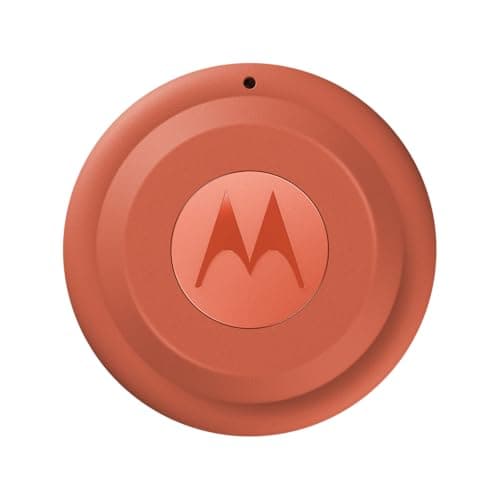
What it is: Motorola's second-generation item tag, announced in January 2026 and built for Google's Find Hub network rather than Apple's. It pairs with any Android device through the moto tag app, it has Ultra Wideband for close-range finding, and there is no subscription for any of it.
The short verdict: if you carry Android and you want the best finding hardware available in a tag, this is it. UWB plus Bluetooth 6.0 channel sounding is better close-range technology than anything Chipolo or Pebblebee ship, the coin cell is replaceable, and Motorola states more than 600 days on one. Two real limitations: it is Android-only, with no iPhone path at all, and at a published 77 dB at 10 cm it is markedly quieter than the tags whose whole pitch is loudness.
The specifications, as Motorola publishes them
| Battery | Coin cell, CR2032, user-replaceable. Motorola states “more than 600 days”. |
|---|
| Water and dust | IP68. |
|---|
| Loudness | 77 dB at 10 cm, Motorola's stated maximum. |
|---|
| Radio | Bluetooth 6.0 with Channel Sounding, plus Ultra Wideband. |
|---|
| Network | Google Find Hub. Motorola lists Find Hub support; there is no Apple Find My mode. |
|---|
| Setup | Pairs with any Android device through the moto tag app. |
|---|
| Size and weight | 31.9 x 31.9 x 8 mm, 8.5 g. |
|---|
| Extras | Shutter button, find-my-phone, location sharing. |
|---|
| Privacy | Unwanted tracking alerts and end-to-end encryption, per Motorola. |
|---|
| Subscription | None. Find Hub is free and Motorola sells no paid tier for the tag. |
|---|
Three-year cost of ownership
The live price above, plus about a dollar a year in coin cells if you take Motorola's 600-day figure as roughly two years per battery. That is the whole number. There is no plan, no paid tier and nothing to decline during setup.
It is worth stating what that is being compared against. Tile's best features now sit behind Life360 memberships published at $9.99 a month for Silver, which is $359.64 over three years on top of the hardware. A tag with no paid tier is not merely cheaper; it is a different kind of purchase, because nothing about it can be moved behind a paywall after you have bought four of them.
What it does better than the alternatives
Close-range finding. Ultra Wideband gives direction and distance rather than a map pin, and Motorola adds Bluetooth 6.0 channel sounding to sharpen the hunt for something just out of view. On Android, the only comparable experience is a Samsung SmartTag2 — and that one requires a Galaxy. Chipolo and Pebblebee have no UWB at all.
A replaceable battery with a long stated life. More than 600 days on a CR2032 you can buy in a supermarket. The rechargeable Find Hub tags ask you to find a cable once a year instead; the sealed ones expire and get thrown away. Why that distinction matters more than it sounds is its own page on this site.
It works with any Android phone. Not just Motorola handsets, which is the mistake people make with this tag, and not just Galaxy, which is the actual restriction on the SmartTag2. A Pixel, a OnePlus or a Nothing phone pairs one fine.
It is IP68. Dust-tight and rated for immersion, which for something that lives on a keyring or in a gym bag is the difference between a four-year life and an accident.
What it gives up
iPhone owners cannot use it. Motorola lists Find Hub support and the retail listing describes it as working with Android Find My Device and Find Hub. There is no Apple Find My mode, so on an iPhone this is the wrong purchase — and unlike Chipolo or Pebblebee, it is not a hedge against switching platforms later.
77 dB is not loud. Most things people lose are lost inside their own home, where the map says “your house” and the alarm does the actual work. Chipolo states 125 dB for the LOOP and Pebblebee states 130 dB for the Clip 5. Against those, the Moto Tag 2 is a quiet tag with excellent direction-finding — which is a real trade, not a spec-sheet quibble.
Channel sounding needs a phone that has it. Bluetooth 6.0 channel sounding only works if the handset supports it, and in late 2026 most do not. UWB has the same caveat. Buy this for the hardware ceiling by all means, but check your own phone before assuming you get the top of it.
Find Hub is a younger, thinner network than Apple's. It is enormous — Android's installed base is — but it has been crowd-finding for far less time, and in quiet places a thinner network means fewer relays and staler positions. That is the real limit on every Android tag, this one included. How accurate these things actually are goes through the mechanism.
Who should buy it
Android owners who lose things in large spaces — a car park, an office, a house with four floors — where knowing the direction beats hearing a chirp.
Anyone who wants a coin cell rather than a cable, and intends to keep the tag for years.
Non-Samsung Android owners who want UWB, which until recently meant buying a Galaxy as well as a tag.
Anyone tagging something that gets wet — a bike, a dog harness, a bag that lives in a truck bed.
Who should skip it
Every iPhone owner. Buy an AirTag, or a Chipolo if you want the option of switching platforms later.
Anyone whose real problem is “it is somewhere in this house”. Buy the loudest tag you can instead; 125 or 130 dB beats 77 dB in a sofa.
Mixed-platform households wanting one tag that works for both people. A Chipolo or a Pebblebee does that; this does not.
Anyone who needs to watch something move. This is a Bluetooth tag with no GPS and no SIM. It reports when another Android phone passes it, which is not tracking.
The alternatives, honestly
Chipolo LOOP — quieter on precision, far louder on alarm, works on either platform, rechargeable. Our most frequent recommendation for Android owners who are not sure what phone they will carry in two years.
Pebblebee Clip 5 — a stated 130 dB and a year per charge, dual-network, no fee. The one to buy if loudness is the deciding factor.
Samsung Galaxy SmartTag2 — only if you carry a Galaxy, in which case it is excellent and has UWB too. The SmartTag2 comparison is here.
A Moto Tag 2 plus a louder tag — not a joke. Two tags on the same bag, one for direction and one for noise, still costs less than three years of any subscription tag in this category. Which is exactly the strategy we recommend for a laptop bag.
If you are weighing it against Apple's tag rather than against other Find Hub devices, the two spec sheets sit side by side here: AirTag vs Moto Tag 2.