These two are the closest comparison on the site, because they are the same kind of product built to the same brief by two companies with similar resources. They are also the comparison you are least likely to be able to act on, because each one requires its own platform.
Still worth doing properly, for two groups: people choosing a phone as well as a tag, and households with both.
Battery — SmartTag2, on the published figure
Samsung states up to 500 days on a replaceable CR2032. Apple states more than a year on a replaceable CR2032, based on everyday average usage of playing sound and Precision Finding.
Five hundred days is roughly sixteen months, so on the published figures Samsung is ahead. Both are approximations by the manufacturers, and both depend heavily on how often the tag is rung. Both take the same cell, which is convenient in a mixed household.
Water resistance — a draw
Both are IP67. Apple cites a maximum depth of 1 meter for up to 30 minutes under IEC standard 60529; Samsung states the same for up to 1 meter of freshwater for up to 30 minutes.
Identical rating, identical caveat: IP67 is a lab figure and resistance is not permanent.
Range — SmartTag2 publishes a number
Samsung states Bluetooth LE 5.3 with up to 120 m range. Apple does not publish a Bluetooth range figure for the AirTag.
Treat that as a difference in disclosure rather than a difference in capability. Direct range is largely beside the point anyway: what finds your keys is the crowd network, not how far your own phone can hear the tag. Why range specs mislead.
Precision finding — both, on their own platforms
Both have Ultra Wideband. Apple's Precision Finding works with a compatible iPhone and, on the second-generation AirTag, Apple states 1.5 times the range of the original plus a speaker 50% louder. Samsung's UWB features need a UWB-enabled Galaxy device.
Comparable capability; each only works inside its own ecosystem.
Network — AirTag, clearly
Find My is built from essentially every iPhone in the world. SmartThings Find includes Galaxy devices only. Both are large; Apple's is larger, and in a thin crowd that is the difference between a report and silence.
Form factor — SmartTag2, and it matters
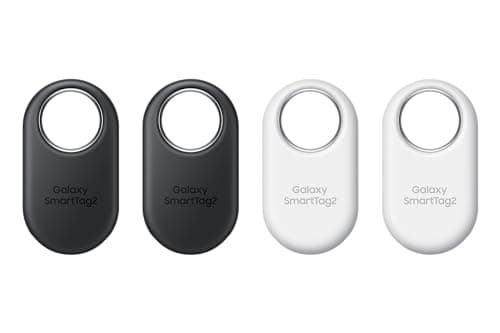
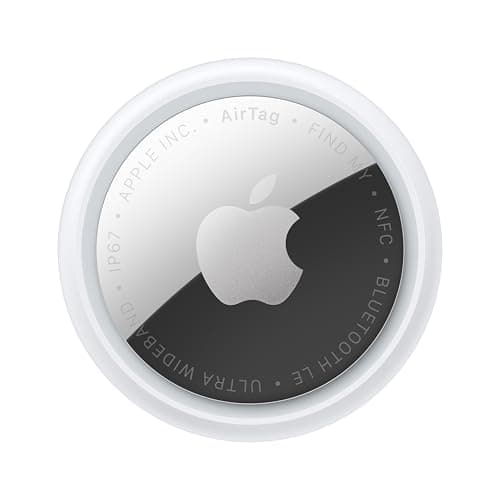
The SmartTag2 is 28.8 × 52.44 × 8.0 mm and 13.75 g, which makes it the physically largest mainstream tag — and it has a hole. The AirTag is a smaller disc with no attachment point at all, so it needs a holder.
Larger but usable beats smaller plus an accessory, for most people.
The short answer
Quick picks
Ranked by what each one costs to own for three years, not by sticker price. The plan column is the one most comparisons leave out.
| # | Product | Best for | Plan / 3 yr | Price |
|---|
| 01 | Apple AirTag (2nd generation)The largest finding network there is, Precision Finding, IP67, and more than a year per CR2032 per Apple. No keyring hole. | iPhone owners | No monthly fee $0 + batteries | $24.00·Amazon |
| 02 | Samsung Galaxy SmartTag2500 stated days, IP67, BLE 5.3 with a stated 120 m, UWB on Galaxy hardware, and a hole for the keyring. Needs a Galaxy, not just Android. | Galaxy owners | No monthly fee $0 + batteries | $52.78·Amazon |
| 03 | Chipolo LOOPFind My or Find Hub, louder than either at a stated 125 dB, with a loop. Gives up UWB precision and gains independence from your phone brand. | If you might change platform | No monthly fee $0 | $33.15·Amazon |
| 04 | CR2032 coin cells (multi-pack)Conveniently, the AirTag and the SmartTag2 use the same CR2032, so one multi-pack covers a household with both platforms in it. | Both take the same cell | No monthly fee $0 | $9.99·Amazon |
#ad · Live prices from Amazon's product API, as of October 8, 2026. Where we have no verified live price we show none — a gap beats a number that has rotted. Plan figures are the brands' own published rates, cited in Sources below.
In detail
The picks, in full
Top pickNo monthly fee#01 · Apple
Apple AirTag (2nd generation)
iPhone owners
The largest finding network there is, Precision Finding, IP67, and more than a year per CR2032 per Apple. No keyring hole.
The subscription reality
No subscription. The only recurring cost is a CR2032 roughly once a year, which is pennies.
- Over three years:
- about $3 in coin cells
Specs, as published by Apple
- ·User-replaceable CR2032 coin cell; Apple states it runs more than a year
- ·IP67 (1 m for up to 30 minutes, IEC 60529)
- ·Ultra Wideband Precision Finding, 1.5x the range of the first generation
- ·Speaker 50% louder than the first generation
Good
- +No subscription, and Apple has never charged one
- +The Find My network is the largest crowd network in the world, so a lost AirTag in a populated area usually reports within minutes
- +Precision Finding walks you to it by distance and direction, not just a map pin
- +Battery is a coin cell from any supermarket, not a sealed pack
Not so good
- −iPhone only for setup and full use — there is no Android app
- −It has no GPS of its own: it reports when an Apple device walks past it, so it is a finder, not a tracker
- −No keyring hole, so you are buying a holder as well
Skip it if
you are on Android, or you need to watch something move in real time — an AirTag only knows where it was when someone last walked past it.
No monthly fee#02 · Samsung
Samsung Galaxy SmartTag2
Galaxy owners
500 stated days, IP67, BLE 5.3 with a stated 120 m, UWB on Galaxy hardware, and a hole for the keyring. Needs a Galaxy, not just Android.
The subscription reality
No subscription. The only recurring cost is a CR2032 roughly once a year, which is pennies.
- Over three years:
- about $3 in coin cells
Specs, as published by Samsung
- ·Replaceable CR2032; Samsung states up to 500 days
- ·IP67 (1 m freshwater up to 30 minutes)
- ·Bluetooth LE 5.3, up to 120 m stated range, plus UWB
- ·28.8 x 52.44 x 8.0 mm, 13.75 g
Good
- +500 days of stated battery life is the longest claim of any mainstream tag
- +No subscription, and SmartThings Find is free
- +UWB gives Samsung phones the same walk-to-it precision iPhones get with AirTag
- +Has a built-in hole, so no holder needed
Not so good
- −Galaxy devices only — Samsung requires a Galaxy phone or tablet on Android 9 or newer
- −SmartThings Find is a smaller network than Apple's Find My
- −Physically the largest of the mainstream tags
Skip it if
your phone is not a Galaxy. A Pixel or a OnePlus will not set this up, whatever the box implies about Android.
No monthly fee#03 · Chipolo
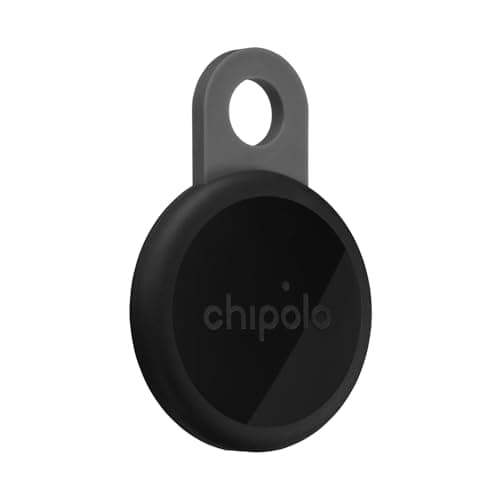
Chipolo LOOP
If you might change platform
Find My or Find Hub, louder than either at a stated 125 dB, with a loop. Gives up UWB precision and gains independence from your phone brand.
The subscription reality
No subscription, now or later. The purchase price is the whole cost of ownership.
- Over three years:
- $0
Specs, as published by Chipolo
- ·Rechargeable over USB-C; Chipolo states about a year per charge
- ·IP67, up to 30 minutes in 1 m of water
- ·About 125 dB stated alarm
- ·Up to 120 m (400 ft) stated Bluetooth range
Good
- +Works with Apple Find My or Google Find Hub, so it is the one tag you can buy without knowing which phone you will own next
- +No subscription at all, and Chipolo's own app features are free
- +Loud — 125 dB stated is well above an AirTag
- +Built-in loop, so it goes straight on a keyring
Not so good
- −You pick one network at setup; switching later means a reset
- −Rechargeable means a dead tag is a tag you have to find a cable for, not swap a coin cell into
- −USB-C cable is not in the box
Skip it if
you would rather drop in a fresh coin cell than remember to charge a keyring once a year.
No monthly fee#04 · Amazon Basics
CR2032 coin cells (multi-pack)
Both take the same cell
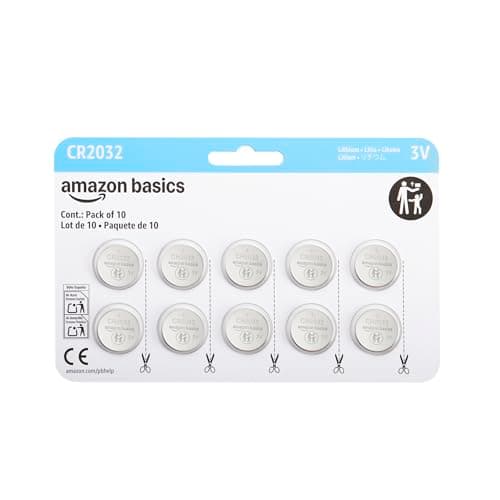
Conveniently, the AirTag and the SmartTag2 use the same CR2032, so one multi-pack covers a household with both platforms in it.
The subscription reality
No subscription, now or later. The purchase price is the whole cost of ownership.
- Over three years:
- $0
Specs, as published by Amazon Basics
- ·CR2032 3V lithium
- ·Multi-pack
- ·The battery used by AirTag and SmartTag2
Good
- +A year of AirTag ownership costs about a dollar in batteries
- +Multi-pack covers several tags for years
- +Universally available
Not so good
- −Some bitter-coated cells do not seat properly in an AirTag — a known, widely reported fit issue
- −Coin cells are a serious swallowing hazard around small children
- −Shelf life is finite
Skip it if
there are toddlers in the house and you will not store these locked away. Coin cells cause severe internal injuries if swallowed.
The recommendation
You have an iPhone: AirTag. The decision is made for you, and the network advantage means you got the better side of it anyway.
You have a Galaxy: SmartTag2. Also made for you, and you get the longer battery claim and the keyring hole as compensation for the smaller network.
You have another Android phone: neither will work. Samsung requires a Galaxy and Apple requires an iPhone. Buy a Find Hub tag.
Your household has both: buy both, which sounds glib and is genuinely the answer — each person uses the tag that matches their phone. They take the same battery, so one multi-pack of CR2032 covers the house.
If this comparison is part of choosing a phone
Then the tag ecosystem is a real but small factor, and the honest weighting is:
Find My is the better network, and if you lose things in thin crowds — rural areas, quiet suburbs — that matters. In a city both are dense enough.
Samsung's tag is the better object, with a hole and a longer battery claim.
Neither should decide a phone purchase. A $25 accessory is not a reason to choose a $900 device, and a dual-network Chipolo gives you most of the capability on either platform for the same money.
The platform-lock cost nobody mentions
Here is the real argument for the third option. Buy four AirTags and switch to a Galaxy in two years, and you own four pieces of plastic. Buy four SmartTags and switch to an iPhone, same outcome.
A dual-network tag can be reset and re-paired to the other network. If you are the sort of person who changes platform, that is worth more than UWB precision — and Chipolo is louder than both of these anyway, at a stated 125 dB.
What neither does
Real-time tracking over distance. Both are Bluetooth beacons that depend on passing phones, so for a car, a dog or a person neither is the right product. That comparison is here.
How we picked
We did not lab-test these trackers
Everyone in this category claims to have tested twenty devices. We have not tested any of them, and we say so on every page. What we did instead: read each manufacturer's published specifications and cite them with the date, find the actual subscription price and cite that too, and work out what thirty-six months of ownership costs at those published figures. Device prices come live from Amazon's API and expire after 48 hours rather than going stale. Where a figure could not be sourced to the manufacturer, the page says the spec is unconfirmed rather than borrowing it from a competitor's review. The full method is on the methodology page.
Working out what a tracker really costs? See the three-year cost of every tracker, compared.
Read next
Related
The table behind every recommendation on this site: device, plan, and what thirty-six months actually comes to.
The three-way comparison, including the cross-platform option.
Full specifications and who should skip it.
Full specifications and three-year cost.
500 days, more than a year, 12 months per charge — what each claim is actually measuring.
Why 120 m on the box has almost nothing to do with whether you find your keys.