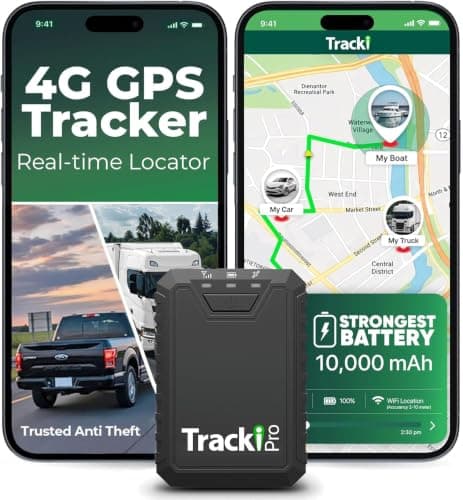
What it is: a battery-powered 4G LTE tracker in a magnetic case, sold with a magnet mount, a mounting plate and 3M tape in the box. Tracki states a 10,000 mAh lithium-ion battery and “2 to 12 months per charge”, qualified as depending on “the mode of operation and cellular network conditions”. It needs an active Tracki plan to report anything.
The specifications, as Tracki publishes them
| Technology | Cellular GPS with a built-in SIM. Tracki lists 4G bands 1/2/3/4/5/7/12/13/17/18/19/20/25/26/38/41, with 3G and 2G fallback named in the page copy. |
|---|
| Battery | 10,000 mAh lithium-ion, stated at “2 to 12 months per charge” depending on mode and network conditions. That is a ten-to-one range, so treat the low end as the planning figure. |
|---|
| Update interval | “15 Seconds - 1 Minute, depending on subscription.” The refresh rate is a plan tier, not a hardware property. |
|---|
| Mounting | Magnet mount, mounting plate and adhesive tape included. No install, no wiring. |
|---|
| Weatherproofing | “Waterproof out of the box. No need for extra accessories.” No IP rating is published, which for an outdoor device is a gap worth naming. |
|---|
| Size | 3.54 x 2.48 x 1.46 inches. This is not a keyring device — the battery is the reason it is the size of a deck of cards. |
|---|
| Warranty | “Lifetime warranty (including lost or damaged device)”, per Tracki. A genuinely unusual term in this category. |
|---|
| Service plan | Required. Tracki publishes one rate anywhere on its site: “Monthly fee options starting at $9.95 for long-term plans.” |
|---|
Three-year cost of ownership — this is the review
The device price above is not the cost of owning this. There is a SIM inside it, a carrier is being paid, and with no active plan the tracker is a brick with a magnet on it.
Tracki's own cheapest published figure is $9.95 a month, offered on long-term plans. Multiply by thirty-six months and the plan costs $358.20. Against a device that typically sells for under twenty-five dollars, that is a plan-to-hardware ratio of roughly fifteen to one — and $9.95 is the best case, because it is the rate for committing years in advance rather than the month-to-month price.
Two details make the arithmetic worse than the headline. First, the update interval is tiered: Tracki states 15 seconds to 1 minute “depending on subscription”, so the fast refresh people imagine they are buying is an upgrade above the cheapest plan. Second, the company sells the tracker in bundles — 6 month, 12 month and 2 years subscription included — which is a fair way to buy it, but it also means the sticker price you compare against a competitor is frequently not the same product.
For context from brands that do publish a rate: Spytec lists $14.95 a month, or $12.95 paid annually, which is $466.20 over three years, and LandAirSea prints $8.95 a month in the title of its Sync OBD product, which is $322.20. Every rate we can cite, multiplied out to thirty-six months. Tracki sits in the middle of that range. It is not an outlier; it is the category.
What Tracki does not publish is a pricing page. There is no page on tracki.com listing the plan tiers, their refresh rates and their prices side by side — the $9.95 figure appears in product marketing copy, and everything above it is discovered during activation. We are not going to guess at the rest of the ladder, and you should establish your actual rate before the device arrives rather than after.
What it is genuinely good at
The battery. A 10,000 mAh cell is several times what most battery-powered trackers carry, and it is the reason a stated figure of months rather than days is plausible. For an asset you visit rarely — a trailer, a towable, a vehicle in long-term storage — the charging trip is the real operating cost of a battery tracker, and this design attacks exactly that.
Deployment in thirty seconds. Magnet, plate and tape in the box, no wiring and no OBD port. That makes it one of the few trackers you can move between assets without tools, which matters if you own more vehicles than trackers.
Real-time reporting, which no tag can do. This is a cellular device: it knows where it is and tells you, rather than waiting for a stranger's phone to walk past. Where it is versus where it was is the difference between recovering a stolen vehicle and filing a report.
The warranty language. “Lifetime warranty (including lost or damaged device)” is a stronger commitment than anything comparable in this price bracket. It is also, read cynically, the behavior of a company whose revenue is the subscription rather than the hardware — which is the same fact as the complaint below, viewed from the other side.
The three real weaknesses
1. The plan is the product. $358.20 across three years at the cheapest published rate, against hardware that costs a fraction of that. There is nothing dishonest about a subscription business, but the sticker price is doing persuasion work it has not earned, and the comparison people make at the checkout — this tracker against a prepaid-service unit several times its price — is not the comparison they are actually making.
2. Published specifications stop short. “Waterproof” with no IP rating, a battery range of 2 to 12 months with no stated test conditions, and a weight figure on the product page that contradicts itself between ounces and grams. None of that makes the device bad; all of it makes the device hard to verify, and on this site an unverifiable spec is reported as unverifiable rather than repeated.
3. No pricing page. The rate ladder is not published. For a purchase whose dominant cost is the plan, the plan should be the easiest thing on the site to find, and the fact that it is not is the single strongest reason to read the activation screen carefully before you pay. Why this whole category is priced this way.
Who should buy it
Anyone tracking an unpowered asset who accepts a subscription. A trailer, a towable, a boat on a mooring, a vehicle in storage — nothing to wire into, long gaps between visits, and a real need to know where it is now. The big battery is the right answer to that problem and the plan is the price of entry.
Anyone who wants live tracking for the lowest possible up-front spend. If cash now matters more than cost over three years — a short-term need, a single trip, a seasonal asset — paying monthly is rational, and this is one of the cheapest doors into live tracking.
Anyone who will lose the device. The lifetime warranty covering a lost or damaged unit is not nothing on a tracker that lives magnetized to the underside of something.
Who should skip it
Anyone who refuses a monthly bill. This is the central case of this site and the answer is a prepaid-service device, where the data cost is collected once inside a higher purchase price. Across thirty-six months that is usually hundreds of dollars cheaper. The no-monthly-fee car trackers and the one-time-payment options.
Anyone tracking a vehicle with 12V available. Hardwire instead and the charging problem disappears permanently, along with the risk of somebody pocketing the device in two seconds. The three install shapes, compared.
Anyone tracking keys, bags, luggage or tools. Those are lost around people, where a no-fee Bluetooth tag beats a cellular tracker outright and costs nothing to run. The tags are here.
Anyone who needs a concealed install. This is a deck-of-cards-sized box on a magnet. For hidden placement in a car there are better shapes — the concealment roundup covers where they go and what gives them away.
The alternatives, named
A prepaid-service magnetic tracker — the same deployment, the same real-time reporting, with the service collected once instead of monthly. The honest comparison for a three-year horizon, and the one we recommend most often. Those are compared here.
Spytec GPS — a longer-established brand that publishes its plan rate on a static page, which is worth something when the plan is the dominant cost. Our review.
Invoxia GPS Tracker PRO — weeks of battery and a motion alert rather than a continuous feed, which is a better mechanism for an asset that should not be moving at all. Its listing is explicit that no subscription is included.
A no-fee Bluetooth tag — if, having read the plan arithmetic, the honest answer is that you want to know which building your thing is in rather than which street, the correct purchase is a tag, bought once, with nothing billed afterward. The three kinds of tracker, explained.