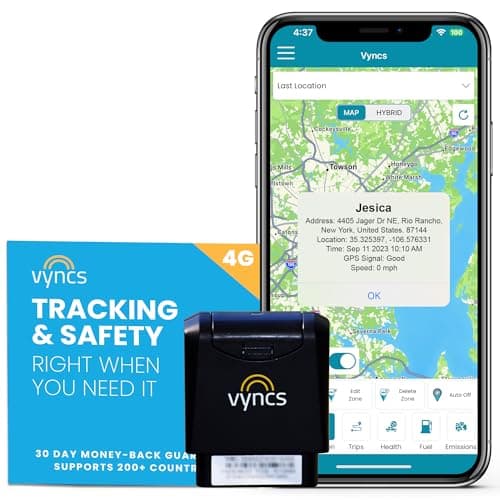
What it is: a 4G cellular GPS tracker that plugs into a vehicle's OBD-II port, marketed as having no monthly fee — because the cellular service is prepaid into the purchase price rather than billed each month.
The specifications
| Install | OBD-II port. Ninety seconds, no tools, vehicle-powered. |
|---|
| Reporting | 60-second interval per the manufacturer's listing. |
|---|
| Features | Live map, trip replay, driving behavior, engine diagnostics. |
|---|
| Charging | None. The car powers it. |
|---|
| Monthly fee | None. Service is prepaid into the purchase price. |
|---|
| Renewal | Prepaid service has a term. The renewal price is the question to establish before buying. |
|---|
Three-year cost of ownership — this is why it is here
Nothing recurring. The purchase price covers the service term, and no card gets charged monthly.
Compare that with the published alternatives. LandAirSea prints $8.95 a month in its Sync product title — $322.20 over three years. Spytec publishes $14.95 monthly or $12.95 paid annually — $466.20 at the annual rate.
The VyncsPro costs considerably more than those devices up front and nothing after. Since its premium is nowhere near $322, it is the cheaper option from somewhere between month twelve and month eighteen onward — which for anyone keeping the car makes it the right buy.
The question to ask: what does renewal cost when the prepaid term ends? That number is not printed on the listing, and it is the thing most likely to surprise you in a few years.
Why “no monthly fee” is true here, and what it hides
This is a real cellular tracker. There is a SIM inside it, a carrier is being paid, and the data genuinely costs money. The difference from a plan-based device is purely when you pay: once, up front, instead of every month.
So the claim is accurate in the sense that matters to your bank statement — nothing recurs. What it does not mean is “no future cost”: the prepaid term ends eventually and the next one has a price. A brand that answers that question clearly before you buy is a brand worth buying from.
What it is good at
Install. Ninety seconds into the OBD port, no tools, and it never needs charging because the car powers it. That removes the single most common failure of battery-powered trackers.
Reporting speed. A 60-second interval is fast for this class and genuinely useful for a stolen-vehicle scenario, where a five-minute interval leaves large gaps.
Trip data and diagnostics. Trip replay, driving behavior and engine codes. On a teenager's first car the diagnostics alone are worth something independent of the tracking.
Platform age. Vyncs has been selling essentially this product for years, which on a device dependent on somebody's servers — and where you have prepaid for several years of service — is a real consideration.
The weaknesses
It is visible. An OBD dongle sits in plain view in the driver's footwell and unplugs in two seconds. This is not a covert device. A ten-dollar OBD splitter moves it up behind the dash and leaves the port free, which helps; for genuine concealment you want a hardwired unit.
It occupies the diagnostic port. The one a mechanic needs. The splitter fixes this too.
Trip history retention. Storage recurs as a cost, so prepaid devices typically keep less history for less time than a subscription device whose servers you fund monthly. If forensic history matters — an insurance dispute, a fleet — read the retention terms.
The up-front price. It is several times a plan-based dongle, which is the whole point and still a real barrier if the budget is this month's.
Who should buy it
Anyone tracking a car they expect to keep and who would rather not have another monthly bill. Over three years this is the cheapest honest way to do it.
Anyone wanting trip data on a new driver, where the declared, visible OBD install is a feature rather than a drawback. That case is here.
Anyone who will not keep a battery tracker charged. The car powers this.
Who should skip it
Anyone who needs the tracker concealed. Buy a hardwired unit. An OBD dongle is the first thing anyone in the driver's seat sees.
Anyone tracking something with no OBD port — a trailer, a motorcycle, a boat. Different device entirely.
Anyone tracking the car for one summer, or a vehicle they are selling. A cancellable monthly plan is genuinely the right product for short-term use, and prepaid is wasted money.
Anyone who actually only needs to know where they parked. A $25 Bluetooth tag in the glovebox does that for nothing.
The alternatives, named
Bouncie — the nicer app and better trip reporting, as a straightforward monthly subscription with no contract.
TuTrackAI — the same no-monthly-fee model at a lower entry price, from a younger brand. On a device whose servers you depend on, brand age is the trade.
FEELION hardwired — no monthly bill and concealable, which is a rare combination. Install required.
LandAirSea Sync — the plan-based equivalent, with $8.95 a month printed in its own title. Cheaper up front, $322 over three years.