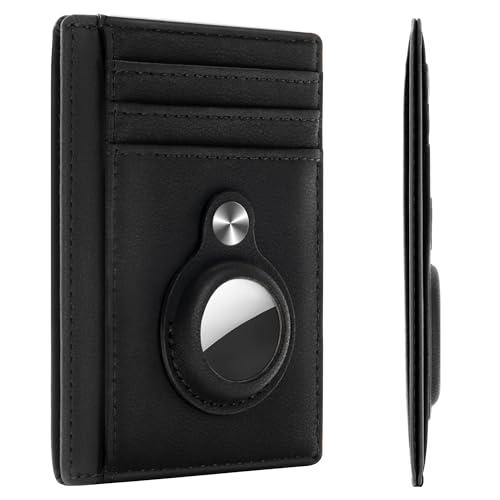
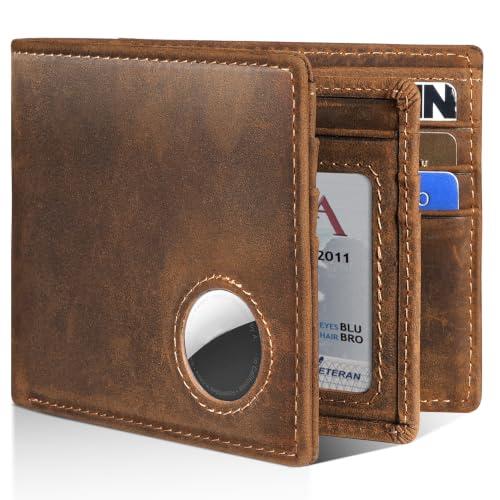
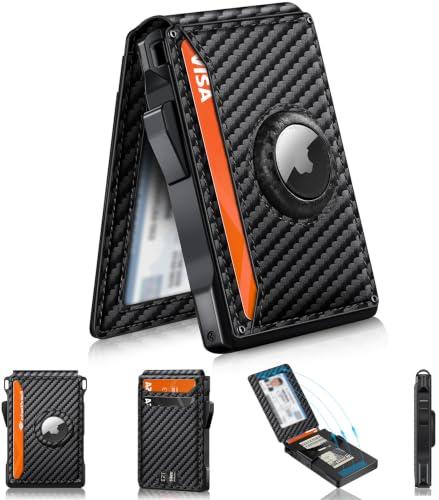
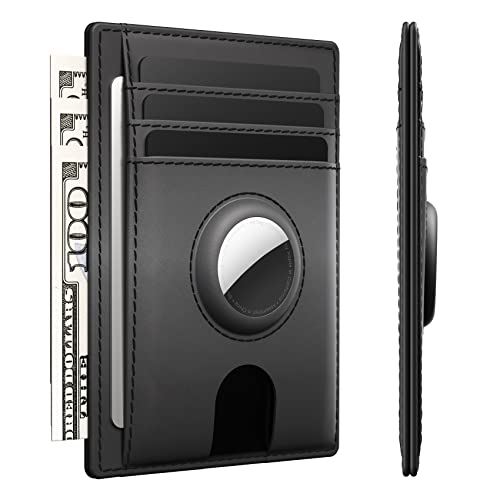
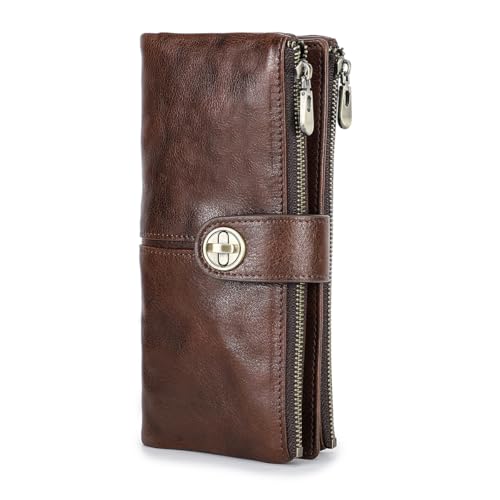
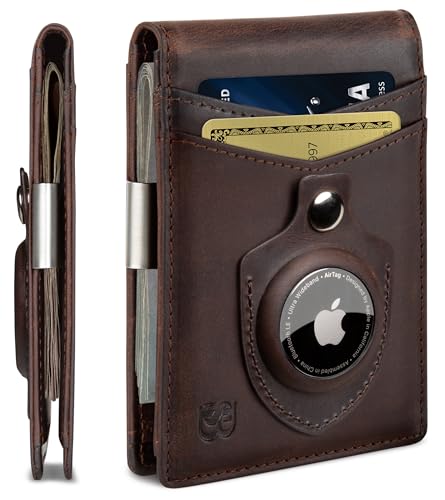
Before any of these: an AirTag is a 31.9 mm disc about 8 mm thick, and a wallet with one inside it gains all 8 mm in a single place rather than spread across the whole wallet. Not one product listing in this category tells you that, and it is the only specification that decides whether you will still be carrying the thing in March. Take whatever you have in your pocket now, add the thickness of three stacked credit cards to one corner of it, and that is the shape you are buying.
With that understood, the category makes sense. A wallet built around a tag pocket is a better object than a wallet with a tag jammed into a card slot, because somebody designed the bulge in rather than leaving you to discover it. The six below do that in four different shapes.
What separates a good one from a bad one
How the tag is held. This is the first thing to check and the easiest to get wrong. A friction slot lets an AirTag work its way loose in a jacket pocket; a snap pocket, a zip or a screwed-down plate does not. The Serman and typecase wallets use a snap; the RUNBOX uses a dedicated pocket in a closed metal body. A wallet where the tag is simply wedged in is the one that will one day be a wallet without a tracker in it.
What sits between the tag and the world. Leather is almost transparent to Bluetooth. Aluminum is not. A metal wallet will still be found — a phone that walks past it will still hear it — but at a shorter distance than a leather one, which matters in a restaurant and matters less in your own house. Nobody prints a figure for this because it depends on the wallet, the phone and what else is in your pocket, so treat it as a ranking rather than a number.
Card count, honestly counted. Wallet listings quote the maximum, and a wallet at maximum capacity is a wallet that will not close. Count what you actually carry today and buy one size up from that, because the AirTag has already spent some of your thickness budget.
Whether anybody stands behind it. This is a category full of near-identical listings from sellers who will not exist in two years. A stated warranty, a brand with a long review history, or both, is a reasonable filter.
The question to settle before you buy any of them
There are three ways to track a wallet, and a wallet with a tag pocket is only one of them.
Buy a wallet built for the tag — this page. You get a proper pocket and a designed-in bulge, and you commit to replacing your wallet rather than adding to it.
Keep your wallet and add a card insert. A card-shaped sleeve holds an AirTag in an existing slot. It is the cheapest route and the most compromised: the sleeve adds its own thickness on top of the tag's, and it can pop out. The holder and case roundup covers those, along with every other way to attach an AirTag to something.
Skip the AirTag entirely and buy a card tracker. A purpose-built card is around 2 mm rather than 8, so it costs you a quarter of the thickness, and the good ones are rechargeable rather than sealed. The wallet tracker ranking sorts those on battery type first. For a tight wallet this is usually the better answer, and saying so on a page about AirTag wallets is the honest thing to do.
Why people choose the AirTag route anyway
Two reasons, and both are legitimate. The first is Precision Finding: on a recent iPhone, an AirTag can be walked to by direction and distance, and no card tracker on the market does that because none of them carries an ultra-wideband chip. If you lose your wallet inside your own house rather than inside a city, that feature is the whole argument.
The second is that people already own AirTags. A four-pack bought for luggage leaves a spare in a drawer, and a wallet with a pocket for it is a free upgrade. If you are starting from zero, price the wallet plus a tag against a card tracker plus the wallet you already like before deciding.
How to fit a tracked wallet into a pocket
Put the tag in the half of the wallet that sits against your leg rather than against your hip, and in a front pocket put it toward the top. The practical difference is comfort rather than signal — 8 mm against a hip bone is noticeable and 8 mm against a thigh is not.
If you carry in a back pocket, prefer the metal case or a wallet with a closure. A snap or a turn-lock is what stops a tag migrating out over a few weeks of sitting on it, and a wallet that has quietly lost its tracker is worse than one that never had one, because you stop checking.
What a tag in a wallet actually gets you
An AirTag has no GPS and no SIM. It reports when somebody else's iPhone passes within Bluetooth range, which in a US town happens constantly and in open country happens never. For a wallet that is close to ideal, because wallets are lost in restaurants, taxis, offices and gyms — all places thick with phones.
What it will not do is tell you where the wallet is going. If it was taken rather than dropped, you get a trail of places it was seen rather than a live position, and the right response to that trail is to call the bank and the police rather than to follow it. Our page on the legal side covers why going to collect your own property yourself is a worse idea than it sounds.
It also will not stay hidden from the person who has it. Apple and Google both alert someone traveling with an unknown tag, on both platforms, so assume a tag in a stolen wallet announces itself within hours. How that alerting works is worth reading in both directions.
Running costs, which are nearly zero
Apple has never charged a subscription for Find My, and none of these wallets adds one, so the recurring cost of a tracked wallet is a CR2032 about once a year. That is the whole bill. It is a useful contrast with the other half of this market, where the device is the small number and the plan is the large one — the three-year cost table puts both side by side.
The one real cost to plan for is replacement. A wallet is a consumable; a tracker is not. Buying a wallet whose tag pocket you can get the tag back out of easily means your next wallet does not have to come from this list.
If the wallet is the thing you keep losing
Worth stepping back: a tracker is a recovery tool, not a prevention tool, and the cheapest fix for a wallet that goes missing weekly is a habit rather than hardware. The same argument applied to keys works just as well here, and left-behind alerts — which Find My will send when you walk away from a tagged item — do more for most people than the map ever does. How separation alerts behave explains which items to turn them on for and which ones will just generate noise.