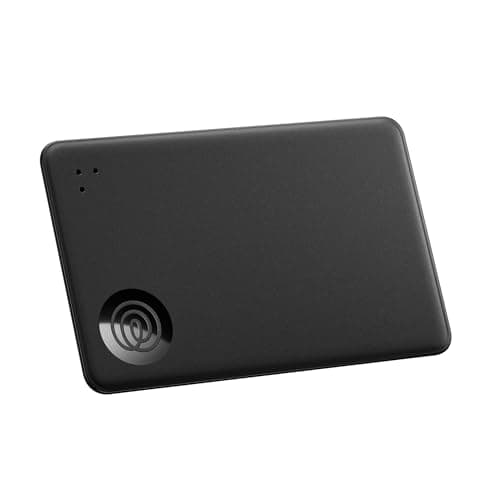
What it is: a credit-card-shaped Bluetooth tracker from Life360, intended for a wallet, a passport holder or a luggage tag. It needs no subscription to do the thing people buy it for — ring it, see where it was last seen, use the community network — and it works on both iPhone and Android, which Apple's own tag does not. Life360 states the card is 53.9 x 85.4 x 2.5 mm and weighs 14 grams.
The verdict in one line: the best-shaped wallet tracker with the worst ownership economics in its class, because the battery cannot be changed and Life360 states it lasts three years.
The specifications, as Life360 publishes them
| Technology | Bluetooth only. There is no GPS and no SIM in this card — it reports when a phone running the network passes within range, which is what every tag in this category does and is the thing most buyers misunderstand. |
|---|
| Range | “Up to 350 feet / 106 meters”, per Life360's product page. That is a clear-line-of-sight ceiling; through a jacket, a wallet and a wall it is a fraction of that. |
|---|
| Battery | “A non-replaceable battery with a 3-year lifespan, no charging required.” Both halves of that sentence matter, and the first half is the review. |
|---|
| Alarm | “104dB+”, per Life360. Loud for a card — Chipolo and Pebblebee's keyring tags are louder, but there is no room for a bigger transducer in 2.5 mm. |
|---|
| Water resistance | IP68, stated as surviving “a 5 feet / 1.5 meter plunge into water, but... not meant for underwater use”. The best rating of any card tracker we have looked at, and the right one for something that lives in a back pocket. |
|---|
| Size and weight | 53.9 x 85.4 x 2.5 mm (2.12 x 3.36 x 0.10 in), 14 g, per Life360. |
|---|
| Platforms | iOS and Android, stated on the listing. This is Tile's remaining structural advantage over an AirTag. |
|---|
| Service plan | Not required. Finding works without paying. Life360 sells optional memberships; location history over thirty days is stated as a Premium Protect feature, and lost-item reimbursement is stated as requiring Premium or Premium Protect. |
|---|
Three-year cost of ownership — this is the review
On this site every product gets the same treatment: what does owning it for thirty-six months actually cost? For most no-fee tags the answer is the purchase price plus a coin cell or two, and the three-year figure is barely above the sticker. The Tile Slim is the interesting exception, and not in its favor.
Life360 states the battery is non-replaceable with a three-year lifespan. There is no cell to swap and no port to charge. So at the end of year three the card is finished, and the only way to keep a tracker in that wallet is to buy another card. The three-year cost of ownership is therefore one card, and then another card — the purchase price is a recurring charge with a thirty-six-month billing cycle.
That is not a scandal and it is not hidden; it is printed on the product page. But it is worth naming plainly, because the entire reason people buy this instead of a subscription tracker is to stop paying for things. A sealed three-year battery is a subscription with extra steps, and it is the single fact that should decide whether you buy this card or a rival.
For comparison, from the manufacturers' own listings: the Chipolo CARD is a rechargeable wallet card, so the same physical product carries on past year three for the cost of a USB charge. The Pebblebee Card 5's own listing title states an 18-month battery and the card is rechargeable too. Both cost more up front than a Tile Slim and less across six years. The full wallet-tracker comparison, including the rechargeable options.
The optional Life360 memberships are a separate question and the honest answer is that most people do not need one. Finding a Tile works on the free tier. The paid tiers add location history, smarter alerts and item reimbursement, and Life360 publishes them at $9.99, $16.99 and $24.99 a month — which, if you took the cheapest paid tier for three years, would be $359.64 on top of the card. That is the version of this product we would not buy, and it is not required.
What it is genuinely good at
The form factor is the best in the category. At 2.5 mm it goes in a card slot rather than making a wallet bulge, which is the whole reason this shape exists. AirTag-in-a-wallet-case solutions are all noticeably thicker because an AirTag is a disc.
It works on Android. This matters more than any spec on the page. An AirTag in an Android household is close to useless, and a card tracker is exactly the product a mixed-platform family wants to buy once and hand to whoever needs it.
IP68 is the right rating for a wallet. Back pockets get rained on and wallets get dropped in puddles. A card tracker that tolerates a 1.5 m plunge is a card tracker that survives normal life.
104dB+ is loud enough for the real job. The find that matters with a wallet is almost always in your own house — down the side of a sofa, in a coat in a closet, under a car seat. A hundred-odd decibels gets through a cushion.
What it is not good at
The network is the thin one. This is the honest structural weakness and it has nothing to do with the hardware. A tracker's chance of reporting from somewhere you are not depends entirely on how many phones are looking for it, and Apple's Find My and Google's Find Hub both run on the installed base of entire mobile platforms. Tile depends on people having installed the Tile or Life360 app. In a dense city the difference may not bite; in a small town it will. If the wallet is gone rather than mislaid, a tag on Apple's or Google's network has the better odds. How the two networks actually compare.
There is no ultra-wideband direction-finding. AirTag's Precision Finding and the SmartTag2's Compass View walk you to a tag with an arrow and a distance. A Tile gives you a map, a last-seen point and a sound. For a wallet in a house that is usually enough; it is still a real feature gap.
The sealed battery, again. It is the cons list and the verdict and the reason we would not buy this one. Everything else about the card is good.
Who should buy it, and who should not
Buy it if you are on Android or in a mixed household, you want the thinnest possible card in your wallet, and you are content to treat the purchase as a three-year consumable. On that framing it is a perfectly honest product: the specs are published, the limitation is published, and no subscription is required to make it work.
Do not buy it if the thing you care about is not paying repeatedly. Buy a rechargeable card instead — Chipolo CARD or Pebblebee Card 5 — and the same physical tracker is still in your wallet in year six. And do not buy it if the real worry is a wallet that is stolen rather than mislaid, because in that scenario the size of the finding network is the only specification that matters and Tile's is the smallest of the three.
If you are choosing across the whole Tile line rather than the wallet case specifically, the keyring models have a different trade-off — and in Tile Pro's case a replaceable cell, which changes the arithmetic above completely. Tile Pro vs Tile Mate covers that comparison, and our Tile Pro review goes through the same cost exercise on the model that lets you change the battery.