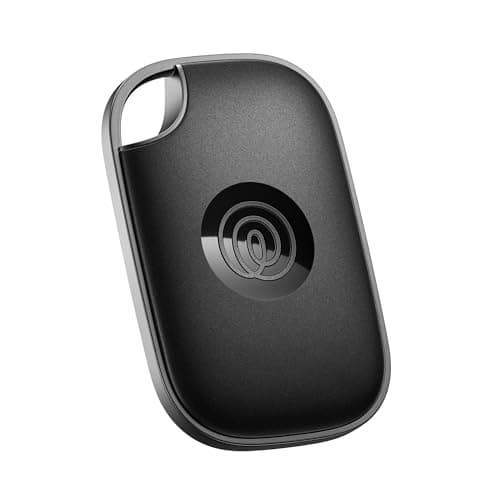
What it is: Tile's flagship Bluetooth tag — the longest-range and loudest of its range, with a replaceable battery and a keyring hole. Tile is owned by Life360, and that ownership shows in the app.
The specifications
| Battery | Replaceable CR2477 coin cell. Note: not the CR2032 most tags use, and much less commonly stocked. |
|---|
| Range | Tile's longest stated Bluetooth range of its range. |
|---|
| Loudness | Tile's loudest ring. Louder than an AirTag, quieter than Pebblebee's stated 130 dB or Chipolo's stated 125 dB. |
|---|
| Network | Tile's own community network, made of other Tile users. The smallest of the major networks. |
|---|
| Platform | iPhone and Android, identically, from one app and account. The reason to buy one. |
|---|
| Attachment | Built-in keyring hole. |
|---|
| Precision finding | None. No Ultra Wideband. |
|---|
Three-year cost of ownership
Without a membership: the live price above, plus a few dollars of CR2477 cells. Finding your Tile — ringing it, seeing its last location, the community network — is free forever.
With a membership: Life360 publishes Silver at $9.99 a month or $99.99 a year, Gold at $16.99 or $169.99, and Platinum at $24.99 or $249.99. At the cheapest monthly tier that is $359.64 over three years, which is more than ten Tile Mates.
What the membership buys: smart alerts when you leave somewhere without a tagged item, 30 days of location history, and item reimbursement. Those are the features in most Tile advertising, which is why people reasonably assume Tile is a subscription product when it is not quite.
The one thing it does that nothing else does
Two people on different phone platforms can find the same tag, from their own phones, on one account.
That is a real need in a lot of households — shared car keys are the classic case — and no other mainstream tag addresses it. An AirTag will not help your Android partner. A dual-network Chipolo picks one network at setup rather than serving both.
If that is your situation, buy a Tile Pro and stop reading comparisons.
The three caveats
1. The network is the smallest. Tile's community network is built from other Tile users, against Apple's network of essentially every iPhone. Since the whole mechanism depends on a participating phone passing your tag, this is the most consequential specification in the category and Tile is behind on it.
2. The battery is a CR2477. Thicker than a CR2032 and far less commonly stocked — you will not find one in a corner shop at short notice. Buy a multi-pack with the tag rather than discovering the difference on the day it dies.
3. The advertising is for the paid tier. Smart alerts are the feature most people want from the list, and they are behind a Life360 membership. The free tier is a complete item finder; it is just not the one in the marketing.
Who should buy it
A household running both iPhone and Android where one tag has to serve everyone. That is genuinely the whole list, and for those people it is the right purchase.
Who should skip it
An all-iPhone household. You would be paying for cross-platform support you will never use, on a smaller network, with no Precision Finding. Buy an AirTag.
An all-Android household. A Find Hub tag gives you a much larger network, a louder alarm and no upsell. Buy a Chipolo, a Pebblebee or a Moto Tag.
Anyone irritated by in-app subscription prompts. Chipolo and Pebblebee have no paid tier at all, so there is nothing to decline.
The alternative that beats it on nearly everything
Chipolo LOOP. Dual-network like a Tile, so it works on whichever platform you are on — on a far larger network, louder at a stated 125 dB, with a loop, and no paid tier.
The one thing it cannot do is serve two platforms simultaneously from one account. And there is a cheap workaround for that: two Chipolos on the same keyring, one paired to Find My and one to Find Hub. Inelegant, works perfectly, and both are on major networks.
We would do that rather than buy a Tile, and almost nobody suggests it.
Tile Pro or Tile Mate?
If you have decided on Tile: the Pro for anything that leaves the house, because of the range and the ring. The Mate for household keys, because it takes the common CR2032 and you are within earshot anyway. The full comparison is here.