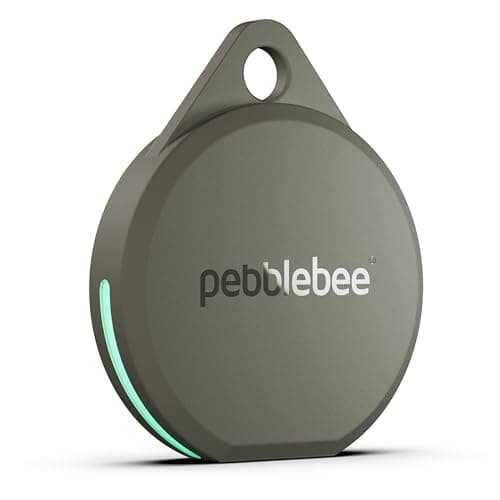
What it is: a rechargeable Bluetooth tag with the loudest siren in mainstream item tracking, working on either Apple Find My or Google Find Hub, with a loop and a twelve-month charge interval.
The specifications, as Pebblebee publishes them
| Battery | Rechargeable, up to 12 months on a single USB-C charge. Cable not included. Pebblebee describes the design as eliminating wasteful coin cells. |
|---|
| Siren | 130 dB stated — the loudest figure in this category. |
|---|
| Water | IP66 — rated against powerful water jets rather than immersion. |
|---|
| Range | 500 ft stated Bluetooth range. |
|---|
| Networks | Apple Find My or Google's Find Hub. Minimum requirement: one of those apps. |
|---|
| Privacy | Pebblebee states that when used with Find My or Find Hub, Pebblebee has no access to your location or tracking data. |
|---|
| Subscription | None. |
|---|
| Attachment | Built-in loop. |
|---|
Three-year cost of ownership
The live price above and nothing else — no subscription, no paid tier, and no batteries, because it recharges. Three annual charges and you are done.
You will want a USB-C cable, which is not in the box. Most households already have several.
Why loudness is the right thing to optimize for
Think about where you actually lose things. Down the side of a sofa. In a coat you wore on Tuesday. In a drawer. In the car door pocket. In every one of those cases the map shows a pin on your own house, which you already knew.
The alarm is what finds them. A 130 dB siren is audible through furniture from the next room; a quieter chirp is not. Against Apple's Precision Finding — which needs you to be in roughly the same room and have line of sight — the siren frequently gets there first.
That is why this tag is our pick for keys specifically, and why we think loudness is the most under-rated specification in the category.
The rating to check
IP66, not IP67. The second digit is the difference: IPX6 is rated against powerful water jets, IPX7 adds temporary immersion.
Practically, the Clip 5 is rain-rated where an AirTag, SmartTag2 or Chipolo LOOP is dunk-rated. For a keyring that will never matter. For a dog that swims, a bike in winter road spray, or anything near a kayak, it does — and in those cases we would choose an IP67 tag or add a sealed case.
The privacy point worth noting
Pebblebee states that when its products are used with Apple Find My or Google Find Hub, Pebblebee itself has no access to your location or tracking data.
That is the correct architecture — the tag maker should be out of the loop, with the relaying handled by Apple's or Google's encrypted network — and it is worth something that Pebblebee says so explicitly rather than leaving it implied.
Who should buy it
Anyone whose main problem is finding things inside a building. Keys, remotes, a bag in a pile of bags. The siren is the feature and it earns its place.
Android owners — this is one of the two best Find Hub tags.
Anyone who might change phone platform, since it is dual-network.
Anyone in a house with toddlers, because rechargeable means no coin cells to store, and a swallowed coin cell is a genuine emergency.
Who should skip it
Anyone putting it on a dog that swims, or a bike in winter. IP66 is the wrong rating for repeated immersion. Choose an IP67 tag or a sealed case.
An iPhone owner who wants Precision Finding for the one item they hunt for in a panic. Buy an AirTag for that and a Pebblebee for everything else.
Anyone who would rather swap a coin cell than find a cable — particularly for a tag in luggage, where a flat rechargeable in a hotel at 6am is its own kind of annoying.
The alternatives, named
Chipolo LOOP — the closest comparison. Slightly quieter at a stated 125 dB and IP67 rather than IP66, so better sealed. Also dual-network and rechargeable.
Apple AirTag — bigger network and Precision Finding on iPhone, quieter, and needs a holder.
Samsung SmartTag2 — if you are on a Galaxy. 500 stated days on a replaceable cell, and a hole.
Pebblebee Card 5 — the same approach in a wallet-card shape, rechargeable so it does not expire.