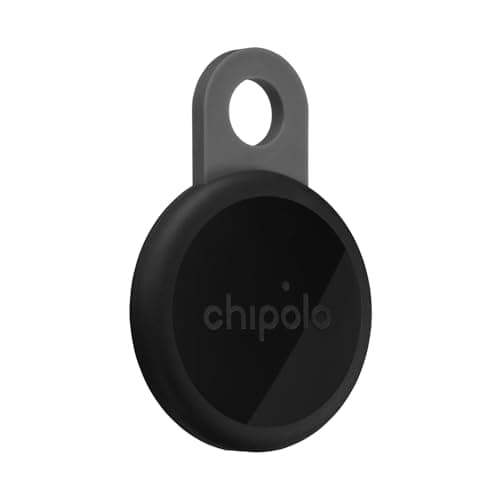
What it is: a rechargeable Bluetooth tag that works on either Apple Find My or Google Find Hub — chosen at setup — with a loud alarm and a loop built into the body. Chipolo replaced its older ONE line with this and the cheaper POP.
The specifications, as Chipolo publishes them
| Battery | Rechargeable over USB-C, approximately one year per charge. Charger not included. |
|---|
| Water and dust | IP67 — waterproof and dust-tight, up to 30 minutes in 1 meter of water. |
|---|
| Loudness | Approximately 125 dB stated. |
|---|
| Range | Up to 120 m (400 ft) stated Bluetooth range. |
|---|
| Networks | Apple Find My or Google Find Hub — one chosen at setup. |
|---|
| Subscription | None. Chipolo states its companion-app extras are free. |
|---|
| Attachment | Built-in loop. |
|---|
| Precision finding | None. No Ultra Wideband. |
|---|
Three-year cost of ownership
The live price above, and nothing else. No subscription, no paid tier, and no batteries to buy because it recharges — so three years of ownership costs exactly what the tag costs plus three annual charges.
Chipolo has no paid tier of any kind, which means there is nothing to decline and no in-app prompting. Against Tile's cheapest Life360 tier at a published $9.99 a month — $359.64 over three years — that is the comparison worth having.
Why this is our most frequent recommendation
It works on either platform. Find My or Find Hub, chosen at setup. On iPhone it rides exactly the same Apple network as an AirTag, so you give up nothing on network size; on Android it rides Google's.
It survives you changing phone. This is the underrated part. Buy four AirTags, switch to Android in two years, and you own four pieces of plastic. Buy four Chipolos and you reset and re-pair them. For anyone not certain about their platform, that hedge is worth real money.
It is louder. A stated 125 dB against an AirTag's quieter chirp. Since most things in this category are lost inside one building — where the map only tells you the keys are in your house — the alarm is doing most of the actual work.
It has a loop. No holder to buy, which is a small saving and a real convenience.
There is no paid tier. Nothing to decline, no prompting.
What it gives up
Precision Finding. Apple's Ultra Wideband walk-to-it arrow is first-party only. On an iPhone you get a map pin from a Chipolo and a direction from an AirTag, which in a cluttered room is a genuine difference — partly offset by the louder alarm.
Coin-cell convenience. Rechargeable means finding a USB-C cable roughly once a year, where an AirTag or SmartTag2 is revived in two minutes with a supermarket battery. Tidier day to day, worse when the tag dies in a hotel.
The charger is not in the box. Minor, and worth knowing.
Who should buy it
Android owners without a Galaxy — this is the best general option on Find Hub.
Anyone who might change phone platform in the next few years.
Anyone whose main problem is finding things in their own house, where loudness beats precision.
Anyone who wants a keyring tag without buying a holder.
Who should skip it
An iPhone owner who is certain they are staying on iPhone and wants Precision Finding for the keys they hunt for in a panic. Buy an AirTag.
A Galaxy owner who would rather have 500 stated days of battery on a replaceable cell. Buy a SmartTag2.
Anyone who would rather swap a coin cell than find a cable.
A mixed-platform household wanting one tag for two people. A Chipolo picks one network — Tile is the only mainstream tag that serves both simultaneously. Though two Chipolos on one keyring, one per network, is cheaper and works.
LOOP, POP or CARD?
LOOP — the flagship and the one reviewed here. Loudest, loop built in.
POP — cheaper, same dual-network support, color-coded shells that genuinely help once you own five tags.
CARD — the wallet version. Rechargeable, so unlike the older sealed wallet cards it does not expire.
If you see a Chipolo ONE listed, note that Chipolo moved to the rechargeable LOOP and POP, so check carefully what you are buying.