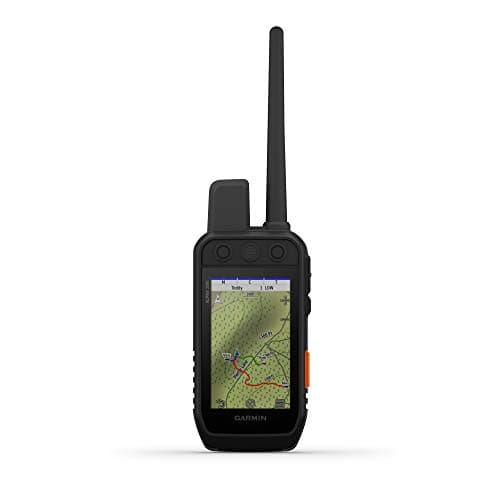
Rural dog owners get sold the wrong product more consistently than anyone else in this category, because both popular technologies fail in open country and for different reasons.
Why a Bluetooth tag fails
A tag has no idea where it is. It broadcasts an identifier and waits for a stranger's phone to hear it and report in. In a town that happens constantly. On two hundred acres of grazing, nobody walks past, so nothing is ever reported. The tag is working perfectly and telling you nothing.
Why a cellular collar fails
This one surprises people, because it feels like the proper solution. A cellular collar does work out its own position from satellites — that part works anywhere with a view of the sky. What it cannot do in a dead zone is send that position, because sending needs a mobile network.
So in a coverage hole the collar knows exactly where your dog is and has no way to tell you. Most devices store the track and upload it when they regain signal, which gives you a precise record of where your dog was an hour ago. That is useful afterwards and useless during.
And coverage holes are not rare in the places dogs actually run: valleys, forestry blocks, the lee of a hill, large estates. If your phone drops out on the walk, the collar will too.
Why radio works
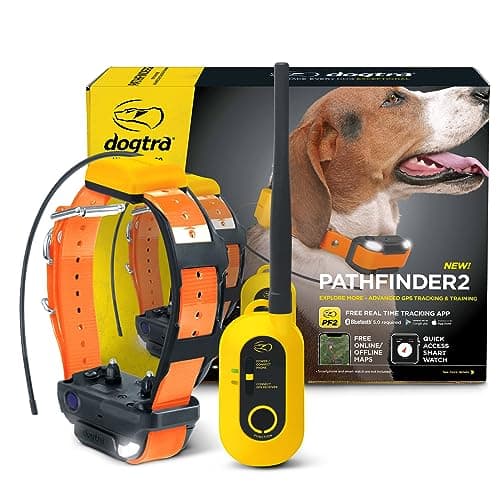
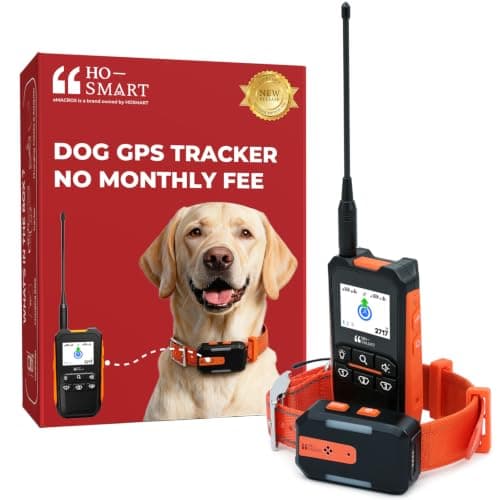
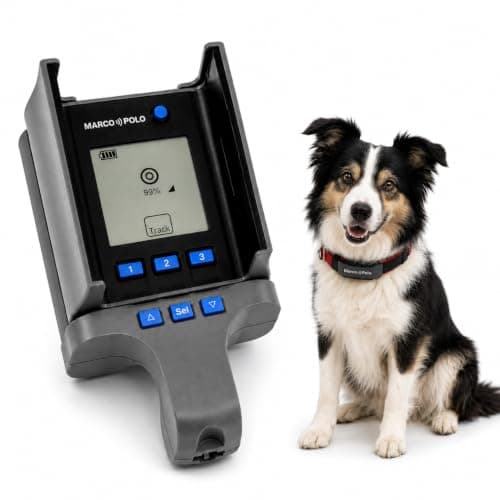
A radio system removes the network from the problem entirely. The collar transmits on license-free radio and a handheld in your pocket receives it directly, giving a distance and a bearing, updating continuously. There is no SIM, no carrier, no servers and no company in the loop — which is why there is no subscription and why nothing can switch it off.
This is what professional hunting-dog equipment uses, and it is not a compromise choice for rural owners. In open country it is the better technology.
The trade: the position exists only on the handheld you are carrying. There is no app, no map to check from the kitchen, no alert while you are at work. You have to be out there, walking toward it. For a working dog that is how you search anyway.
Checking your own coverage before you buy
Do this before spending anything, because it decides the answer. Walk the places your dog actually goes with your phone in your hand, and note where you lose signal. Not the carrier's coverage map — your phone, in those fields.
If you have signal everywhere your dog runs, a cellular collar is a perfectly good choice and gives you the thing radio cannot: a map you can look at from the house. If you lose signal in the valley your dog always heads for, a cellular collar will fail there specifically, every time.
One nuance worth knowing: a collar at ground level in a dip has considerably worse reception than a phone held at head height on a track. Your own signal is the optimistic case.
What radio range figures really mean
A stated three miles or nine miles is open-country, line-of-sight. Radio does not bend round hills.
Practically: a ridge between you and the dog can cut the usable range to a fraction. Dense conifer plantation absorbs signal badly. Rolling open grassland is close to the best case, and the quoted figures are achievable there.
The technique that follows from this is simple and worth knowing: when you lose the signal, go up. Height restores line of sight faster than walking toward where you think the dog went. Experienced users of these systems head for the nearest high ground first, every time.
Multiple dogs, which decides it for many owners
Every cellular platform we are aware of charges per tracker. Two dogs on Tractive's published Basic rate is $504 across three years; three dogs is $756.
A radio handheld tracks multiple collars — the Garmin Alpha handles up to twenty — and adding a dog means buying a collar, not a plan. For a household with several working dogs the arithmetic is not close, and that is before the coverage argument.
Your own safety, which belongs on this page
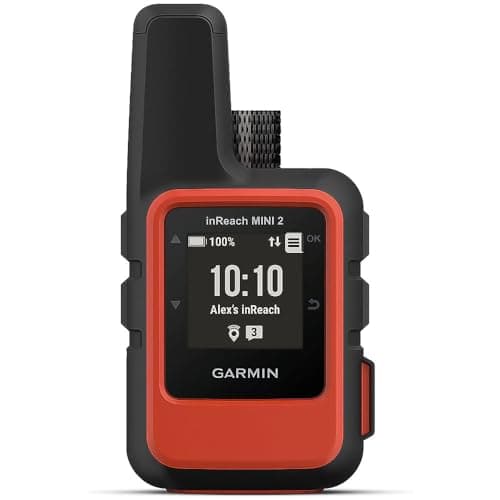
If you are searching for a dog in places with no phone coverage, consider that nobody knows where you are either. A satellite communicator like the inReach Mini 2 gives you two-way messaging and an SOS that works where there is no cellular, and location sharing somebody at home can watch. It needs its own airtime plan, which is the honest cost.
The Garmin Alpha 200i combines both functions in one device — dog tracking over radio with no fee, and inReach satellite messaging if you choose to subscribe to it. For someone genuinely working dogs off-grid that combination is the reason to pay what it costs.
The honest hybrid
Many rural owners end up with two things, and it is a sensible setup: a radio system for the fields, and a cheap Bluetooth tag on the same collar for the case where the dog ends up in the village. They cover each other's gaps exactly, the tag costs almost nothing, and neither has a subscription.