Skip to content
Tag & Tether

Head to head · Tracker Comparisons

Bluetooth tags vs cellular GPS vs radio

Three technologies that look like price tiers and are actually different products. This is the page that makes the rest of the site make sense.

By Mike M.Last updated

#ad — we earn a commission if you buy through the links on this page, at no cost to you. It never changes what we recommend, and the structural reason it cannot is that we recommend the no-subscription devices, which pay the least. Full disclosure.


Almost every bad purchase in this category comes from treating these three as cheap, medium and expensive versions of the same thing. They are not. They solve different problems and fail in different places, and once you can see that, the rest of this site is detail.

Bluetooth crowd-network tags

How it gets a position: it does not. The tag broadcasts a rotating, encrypted identifier a few times a second. Any participating phone that hears it submits an encrypted report of where it was heard. You see the result.

What it costs: the tag, plus about a dollar a year in batteries. Roughly $30 over three years. There is no data cost for anyone to recover, which is why there is no subscription and structurally cannot easily be one.

Where it works: wherever there are participating phones. Airports, cities, suburbs, shopping centers — superbly. Fields, woodland, containers, empty roads at night — not at all.

Battery: about a year. Apple states more than a year per CR2032; Samsung states up to 500 days.

Failure mode: silence in thin crowds. The tag is working perfectly and telling you nothing.

Cellular GPS trackers

How it gets a position: a satellite receiver works out where the device is — free, and works anywhere with sky — and a cellular modem sends it over a mobile network.

What it costs: the device, plus data. From published rates: $8.95 a month on the LandAirSea Sync, which is $322 over three years; $12.95 a month paid annually on Spytec, which is $466. Prepaid-service devices collect the same cost in one payment instead.

Where it works: anywhere with cellular coverage, which is most of the populated world. It fails in dead zones, where it stores the track and uploads on regaining signal — and, counter-intuitively, often inside large steel-framed buildings where tags do better.

Battery: days to months, dominated entirely by reporting interval. The same hardware can last a week at sixty-second reporting or four months at twice a day.

Failure mode: two. A dead battery, and the company going away — the SIM, the servers and the app all belong to the brand. whistle.com now 301s to tractive.com and tryfi.com to fitracking.com; we checked both.

Radio direction-finding

How it gets a position: a handheld unit and a collar or tag talk directly over license-free radio. The handheld computes a bearing and a distance. No infrastructure of any kind is involved.

What it costs: a lot once, then nothing. No SIM, no network, no company in the loop, so there is nothing to subscribe to and nothing that can be switched off.

Where it works: open country, superbly, including places with zero phone coverage. Range collapses around hills and dense woodland, and is poor in built-up areas.

Battery: good, and you are charging a handheld as well as a collar.

Failure mode: the position exists only on the handheld in your hand. No app, no alert while you are at work, no map from the kitchen. You have to be out there.

And a fourth: satellite

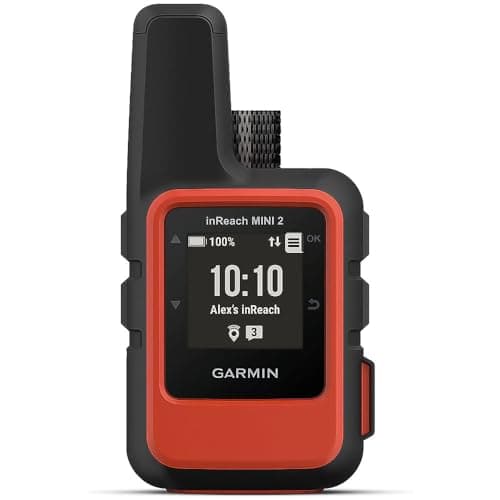
Worth naming because people searching for “no SIM” land on it. Satellite communicators like the inReach Mini 2 talk to satellites rather than cell towers, so coverage is genuinely global. There is no SIM — and satellite airtime is its own subscription, so SIM-free is not fee-free. It is a person-safety product rather than an item tracker.

The short answer

Quick picks

Ranked by what each one costs to own for three years, not by sticker price. The plan column is the one most comparisons leave out.

#ProductBest forPlan / 3 yrPrice
01
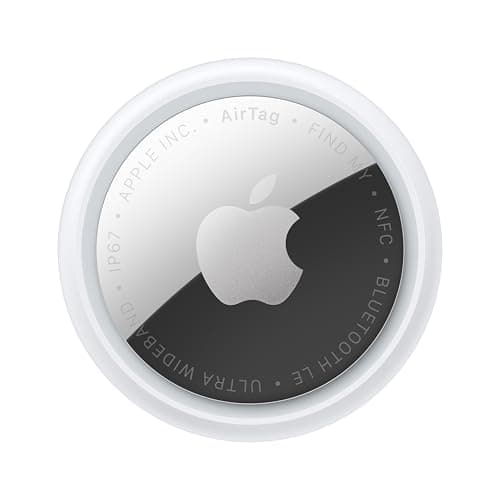
Apple Apple AirTag (2nd generation)
Apple AirTag (2nd generation)

No GPS, no SIM. Reports through passing phones, costs about $30 over three years, and is silent where there is nobody.

Bluetooth: around people, free foreverNo monthly fee

$0 + batteries

$24.00Amazon
02
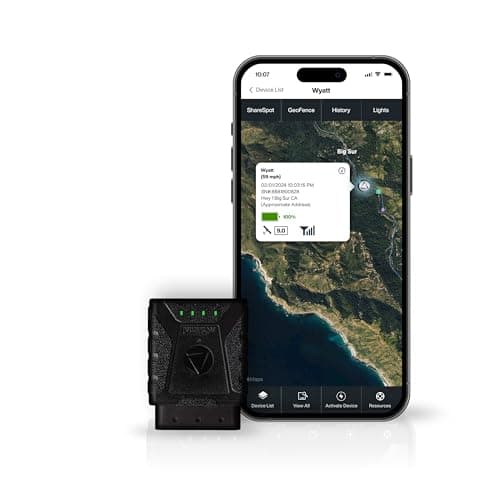
LandAirSea LandAirSea Sync (OBD-II)
LandAirSea Sync (OBD-II)

Satellite positioning plus a SIM, reporting whether anyone is nearby or not. $8.95 a month per its own listing — $322 over three years.

Cellular: anywhere with signalPlan required

+$322 / 3 yr

$24.95Amazon
03
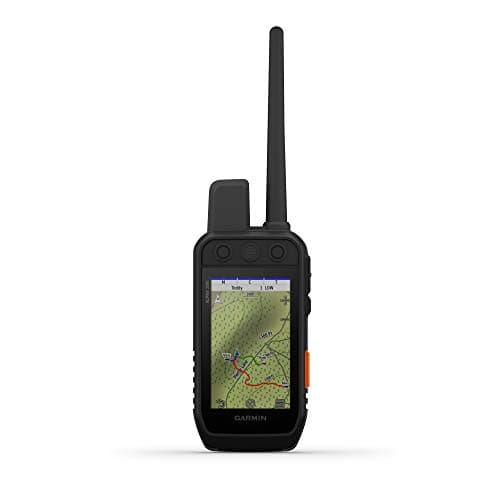
Garmin Garmin Alpha 200i handheld
Garmin Alpha 200i handheld

A handheld talking straight to the collar with no network at all. Live tracking with no subscription, working where cellular does not.

Radio: live, off-grid, no feePlan required

Plan for satellite

$697.00Amazon
04
Garmin Garmin inReach Mini 2
Garmin inReach Mini 2

Beyond all cellular coverage, globally. Not a SIM, but satellite airtime is its own subscription — so SIM-free is not fee-free here.

Satellite: the fourth optionPlan required

Plan for satellite

$299.00Amazon

#ad · Live prices from Amazon's product API, as of October 8, 2026. Where we have no verified live price we show none — a gap beats a number that has rotted. Plan figures are the brands' own published rates, cited in Sources below.

In detail

The picks, in full

Apple Apple AirTag (2nd generation)
$24.00View on Amazon

$29.0017% off

Price as of October 8, 2026. Prices move — Amazon's at checkout is the one that counts.

#ad · we may earn a commission from this link to Apple AirTag (2nd generation)

Top pickNo monthly fee#01 · Apple

Apple AirTag (2nd generation)

Bluetooth: around people, free forever

No GPS, no SIM. Reports through passing phones, costs about $30 over three years, and is silent where there is nobody.

The subscription reality

No subscription. The only recurring cost is a CR2032 roughly once a year, which is pennies.

Over three years:
about $3 in coin cells

Specs, as published by Apple

  • User-replaceable CR2032 coin cell; Apple states it runs more than a year
  • IP67 (1 m for up to 30 minutes, IEC 60529)
  • Ultra Wideband Precision Finding, 1.5x the range of the first generation
  • Speaker 50% louder than the first generation

Good

  • No subscription, and Apple has never charged one
  • The Find My network is the largest crowd network in the world, so a lost AirTag in a populated area usually reports within minutes
  • Precision Finding walks you to it by distance and direction, not just a map pin
  • Battery is a coin cell from any supermarket, not a sealed pack

Not so good

  • iPhone only for setup and full use — there is no Android app
  • It has no GPS of its own: it reports when an Apple device walks past it, so it is a finder, not a tracker
  • No keyring hole, so you are buying a holder as well

Skip it if

you are on Android, or you need to watch something move in real time — an AirTag only knows where it was when someone last walked past it.

LandAirSea LandAirSea Sync (OBD-II)
$24.95View on Amazon

Price as of October 8, 2026. Prices move — Amazon's at checkout is the one that counts.

#ad · we may earn a commission from this link to LandAirSea Sync (OBD-II)

Plan required#02 · LandAirSea

LandAirSea Sync (OBD-II)

Cellular: anywhere with signal

Satellite positioning plus a SIM, reporting whether anyone is nearby or not. $8.95 a month per its own listing — $322 over three years.

The subscription reality

LandAirSea puts the $8.95/month figure in the product's own title, which is more honest than most of this category manages.

Published monthly:
$8.95
Over three years:
$322.20

Specs, as published by LandAirSea

  • Plugs into the OBD-II port, so it is powered by the vehicle
  • 4G LTE
  • LandAirSea states $8.95 per month in the product title itself

Good

  • No charging, ever — the car powers it
  • Two-minute install with no tools
  • LandAirSea publishes the monthly price on the listing, which is rarer than it should be

Not so good

  • $8.95 a month is $322 over three years, which dwarfs the device price
  • An OBD dongle is the first place anyone looks
  • Occupies the diagnostic port a mechanic needs

Skip it if

you are tracking a vehicle covertly. An OBD dongle is visible from the driver's seat.

Garmin Garmin Alpha 200i handheld
$697.00View on Amazon

$749.997% off

Price as of October 8, 2026. Prices move — Amazon's at checkout is the one that counts.

#ad · we may earn a commission from this link to Garmin Alpha 200i handheld

Plan required#03 · Garmin

Garmin Alpha 200i handheld

Radio: live, off-grid, no fee

A handheld talking straight to the collar with no network at all. Live tracking with no subscription, working where cellular does not.

The subscription reality

The handheld works as a GPS and as a dog tracker with no fee at all. The inReach satellite messaging is the part that needs an airtime plan, and only if you want it.

Specs, as published by Garmin

  • Handheld radio tracker for up to 20 Garmin dog collars
  • Built-in inReach satellite messaging (airtime plan optional)
  • Topographic mapping on the handheld

Good

  • Dog tracking itself needs no subscription — the radio link is free forever
  • Works with zero phone signal, which is the entire point for hunting dogs
  • inReach gives you an SOS in places with no coverage, if you want the plan

Not so good

  • Very expensive, and the collars are sold separately
  • Satellite messaging is the part that needs an airtime plan
  • Overkill for a pet dog

Skip it if

the dog is a family pet. This is professional hunting-dog equipment and priced like it.

Garmin Garmin inReach Mini 2
$299.00View on Amazon

$399.9925% off

Price as of October 8, 2026. Prices move — Amazon's at checkout is the one that counts.

#ad · we may earn a commission from this link to Garmin inReach Mini 2

Plan required#04 · Garmin

Garmin inReach Mini 2

Satellite: the fourth option

Beyond all cellular coverage, globally. Not a SIM, but satellite airtime is its own subscription — so SIM-free is not fee-free here.

The subscription reality

The handheld works as a GPS and as a dog tracker with no fee at all. The inReach satellite messaging is the part that needs an airtime plan, and only if you want it.

Specs, as published by Garmin

  • Two-way satellite messaging and SOS via the Iridium network
  • Location sharing with no cell coverage
  • Requires an active airtime plan for messaging

Good

  • Works where no cellular tracker does, anywhere on earth
  • SOS goes to a 24/7 coordination center
  • Location sharing a family member can watch from home

Not so good

  • Airtime plan required for messaging and SOS
  • Expensive device
  • It tracks the person carrying it, not an object you lost

Skip it if

you never leave cell coverage — you are paying for satellites you will not use.

The matching table

Around people, cheap, good enough: Bluetooth. Keys, wallet, luggage, tools, camera bag, a dog in a suburb, a car in a car park, a bike in a city.

Anywhere with signal, live, worth paying for: cellular. A car you want recovered, a dog that works a field near coverage, a person at risk of wandering, a trailer on a road.

Off-grid, live, free forever: radio. Hunting dogs, moorland, forestry, any genuine dead zone. The forgotten option and frequently the right one.

Beyond all coverage, for a person: satellite.

The three mistakes this page prevents

Buying cellular for a job a tag does. $484 over three years to track a suitcase that lives in airports full of iPhones.

Buying a tag for a job that needs cellular. A tag on a dog that works a field is silent at exactly the moment you needed it, and that is not a saving.

Not knowing radio exists. Rural dog owners are sold cellular collars that fail in the valley their dog always heads for, when a radio system would work there and cost nothing to run.

Combining them

The technologies are complementary rather than competing, and the best setups use two.

Cellular plus Bluetooth on anything valuable: the cellular unit does live tracking, and a hidden tag covers the two failures it cannot — flat battery, and being found and removed.

Radio plus Bluetooth for a rural dog: radio for the fields, a tag on the same collar for the day the dog ends up in the village.

In both cases the second device costs about twenty-five dollars and has no running cost.

One last way to tell them apart

A simple test that works every time. Can this device tell me where the thing is while I am a hundred miles away and nobody is near it?

Yes means there is a SIM and a cost. No, but it tells me where it was means Bluetooth. Yes, but only if I am standing outside with a handheld means radio. There are no exceptions.
How we picked

We did not lab-test these trackers

Everyone in this category claims to have tested twenty devices. We have not tested any of them, and we say so on every page. What we did instead: read each manufacturer's published specifications and cite them with the date, find the actual subscription price and cite that too, and work out what thirty-six months of ownership costs at those published figures. Device prices come live from Amazon's API and expire after 48 hours rather than going stale. Where a figure could not be sourced to the manufacturer, the page says the spec is unconfirmed rather than borrowing it from a competitor's review. The full method is on the methodology page.

Working out what a tracker really costs? See the three-year cost of every tracker, compared.

Questions

Frequently asked

What is the difference between a Bluetooth tag and a GPS tracker?
A Bluetooth tag has no idea where it is — it broadcasts an encrypted identifier and borrows a position from whichever stranger's phone hears it, which is why it costs nothing to run and why it goes silent where there are no people. A cellular GPS tracker works out its own position from satellites and sends it over a mobile network, independent of bystanders. That independence is the whole value and the cellular data is the whole cost.
What is a radio tracker and why is it free?
A handheld unit that talks directly to a collar or tag over license-free radio, giving a bearing and a distance with no infrastructure in between. It is free because there is no SIM, no carrier, no servers and no company in the loop — there is literally nobody to pay. It works with zero phone coverage, which is why professional hunting-dog kit still uses it. The trade is that the position only exists on the handheld you are carrying.
Which technology is cheapest to own?
Bluetooth, by a wide margin — about $30 over three years including batteries. Radio is expensive to buy and free to own, so it wins over five years or more and wins immediately if you have several animals, because you add a collar rather than a plan. Cellular is cheapest to buy and most expensive to own: $322 over three years at the lowest published plan rate we cover, and $466 at Spytec's.
Which one works with no phone signal?
Radio direction-finding, for live tracking, with no subscription at all. Satellite, for a person, with its own airtime plan. Bluetooth tags need passing phones, which dead zones do not have; cellular trackers need a mobile network, which dead zones also do not have — a cellular tracker in a coverage hole knows exactly where it is and cannot tell you.
Can I combine two technologies?
Yes, and the best setups do, because the second device costs about twenty-five dollars with no running cost. Cellular plus a hidden Bluetooth tag on anything valuable: the cellular unit does live tracking and the tag covers the two failures it cannot — a flat battery, and being found and removed. Radio plus a tag for a rural dog: radio for the fields, the tag for the day the dog ends up in the village.
How can I tell which technology a product uses?
One test, and it works every time: can it tell you where the thing is while you are a hundred miles away and nobody is near it? Yes means there is a SIM and therefore a cost. No, but it tells you where it was means Bluetooth. Yes, but only if you are standing outside holding a handheld means radio. If a listing claims the first with no cost of any kind, read the description again.

Read next

Where the figures came from

Sources

Every specification and plan price on this page traces to one of these, read on the date shown. Device prices are live from Amazon and stamped separately.

  1. Apple — AirTag product page (battery, IP67, Precision Finding) — accessed 2026-10-05
  2. Samsung — Galaxy SmartTag2 specifications — accessed 2026-10-05
  3. LandAirSea — service plans — accessed 2026-10-05
  4. Spytec GPS — plan pricing ($14.95/mo monthly, $12.95/mo paid annually) — accessed 2026-10-05
  5. whistle.com — returns HTTP 301 to tractive.com (checked directly) — accessed 2026-10-05
  6. tryfi.com — returns HTTP 301 to fitracking.com (checked directly) — accessed 2026-10-05
  7. Amazon Product Advertising / Creators API — live prices and product images — accessed 2026-10-05