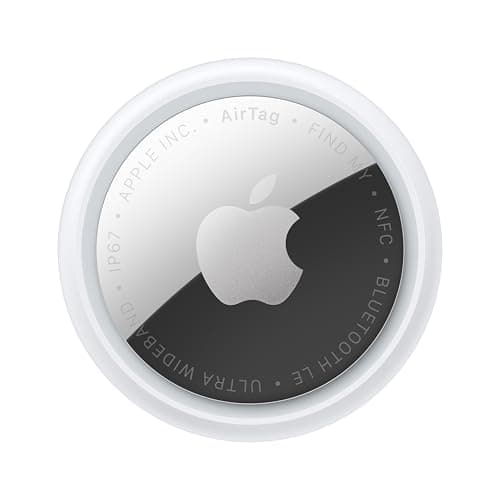
This takes about thirty seconds and needs no tools. Apple states that an AirTag works for more than a year on a standard user-replaceable battery, based on everyday average usage of playing sound and Precision Finding — so expect to do this roughly annually.
What you need
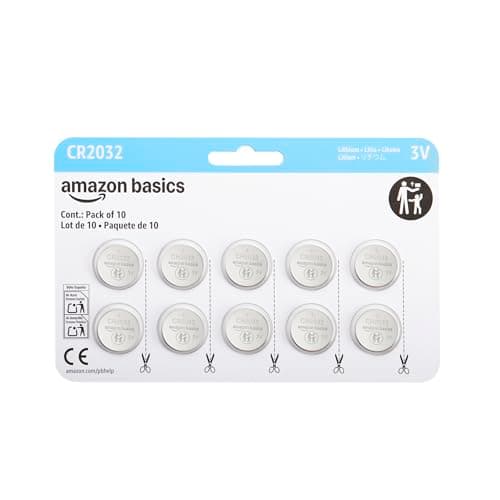
A CR2032 3V lithium coin cell. Not a CR2025 (too thin) and not a CR2477 (that is a Tile Pro). The same cell a Samsung SmartTag2 uses, so one multi-pack covers a mixed household.
The procedure
1. Hold the AirTag with the white plastic side down and the polished stainless cover facing up.
2. Press down firmly on the stainless cover and twist it counterclockwise until it stops. It only moves a short distance.
3. Lift the cover off. The battery is underneath.
4. Take the old cell out. Put the new one in with the positive side facing up — the side with the writing on it.
5. You should hear a chirp. That is the tag confirming power. If there is no chirp, see the section below.
6. Refit the cover, aligning the three tabs with the slots, press down and twist clockwise until it stops.
That is it. The tag keeps its pairing — you do not need to set it up again.
The problem that makes people think the tag is broken
Here is the issue that generates most of the confusion in this area, and it has nothing to do with the AirTag.
Some CR2032 cells have a bitter-tasting coating applied as a child-safety deterrent to discourage swallowing. On many devices it makes no difference. In an AirTag, that coating can sit between the cell and the contact and prevent proper electrical connection.
The symptom is distinctive: a brand-new battery, a tag that will not chirp, and a cell that tests fine on a meter. Apple itself notes that batteries with bitterant coatings may not work with AirTag.
The fix is simply to use an uncoated cell. Do not conclude the tag is dead.
Troubleshooting, in order
No chirp when you fit the battery. First check the orientation — positive side up, writing facing you. Then suspect the bitterant coating and try a different brand of cell. Then check the contacts for debris.
The cover will not twist off. You are probably not pressing hard enough while twisting. It takes real downward pressure, not finesse. Push firmly with your thumb and rotate.
The cover will not go back on. The three tabs have to align with the three slots. Rotate the cover a few degrees and try again — it only seats one way.
It chirps but shows as offline in Find My. Give it a minute and move within Bluetooth range of your phone. If it still does not appear, the issue is pairing rather than power.
Which batteries to buy
A multi-pack of branded CR2032 from a maker you recognize, uncoated. Cheap unbranded cells are a false economy twice over: they have less capacity, and they are more likely to arrive partly discharged after sitting in a warehouse.
Check the date code if there is one. A coin cell loses capacity on the shelf, so a pack manufactured three years ago starts at a disadvantage.
The safety part, which is not optional
Coin cells cause severe internal injuries if swallowed, within hours, through electrolysis rather than poisoning. This is a genuine emergency, not a watch-and-wait, and it is the reason the bitterant coatings exist in the first place.
Practical measures: keep spares in their retail card and locked away, never loose in a drawer. Dispose of the old cell immediately rather than leaving it on a worktop — a partially-discharged cell is still dangerous. And treat an AirTag with a loose or damaged cover as a today problem.
In a house with toddlers, rechargeable tags from Chipolo or Pebblebee remove this issue entirely, which is a real reason to prefer them.
When to do it
When your iPhone tells you, and not later. The notification arrives with time to spare, and the failure mode of ignoring it is a tag that is flat on the day you needed it.
A better habit: once or twice a year, open Find My and ring every tag you own. A tag that does not ring has a dead battery. Two minutes, and it catches the notifications you dismissed without reading.
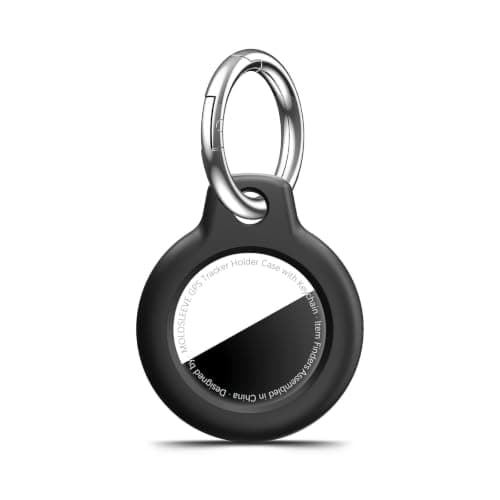
And check your holder before you buy it — a case you have to destroy to reach the battery is a case you will replace annually.