Skip to content
Tag & Tether

One device at a time · Tracker Reviews

Apple AirTag review

The default no-fee tag for iPhone owners, with the largest finding network there is — and one design flaw that costs you a few dollars more.

By Mike M.Last updated

#ad — we earn a commission if you buy through the links on this page, at no cost to you. It never changes what we recommend, and the structural reason it cannot is that we recommend the no-subscription devices, which pay the least. Full disclosure.


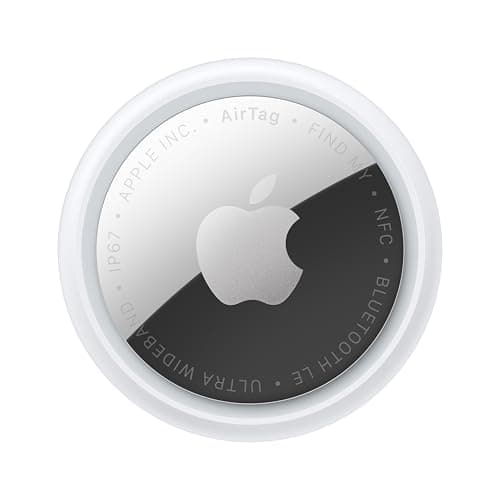
What it is: a Bluetooth beacon with a speaker, an Ultra Wideband radio and a replaceable coin cell. No GPS receiver and no SIM, which is why it costs nothing to run and why it reports where something was rather than where it is.

The specifications, as Apple publishes them

BatteryUser-replaceable CR2032 coin cell. Apple states it works for more than a year, based on everyday average usage of playing sound and Precision Finding.
Water and dustIP67, tested under controlled laboratory conditions to a maximum depth of 1 meter for up to 30 minutes under IEC standard 60529. Apple notes resistance is not permanent and may decrease with normal wear.
Precision FindingUltra Wideband. Apple states the second generation has 1.5 times the Precision Finding range of the original.
SpeakerApple states 50% louder than the first generation.
NetworkApple Find My — the largest crowd network in the world. Apple describes the relaying as anonymous and encrypted.
PlatformiPhone only. There is no Android app.
AttachmentNone. No hole, no loop.

Three-year cost of ownership

The live price above, plus about three dollars of CR2032 cells over three years, plus a three-dollar keyring shell if it is going on keys. Call it the tag price plus six dollars.

There is no subscription, no paid tier and no iCloud+ requirement — Find My tracking works on a free Apple Account. That is not a promotional position: the data that locates your tag is carried by strangers' phone plans, so there is no recurring cost for Apple to recover. Why that makes a subscription structurally unlikely.

For comparison, the cheapest published cellular tracker plan we cover is $8.95 a month — $322 across the same three years.

Apple Apple AirTag (2nd generation)
$24.00View on Amazon

$29.0017% off

Price as of October 8, 2026. Prices move — Amazon's at checkout is the one that counts.

#ad · we may earn a commission from this link to Apple AirTag (2nd generation)

No monthly feeApple

Apple AirTag (2nd generation)

iPhone owners, almost anything

The best no-fee tag you can buy if you carry an iPhone, and the one to skip if you do not. About $30 to own for three years, all in.

The subscription reality

No subscription. The only recurring cost is a CR2032 roughly once a year, which is pennies.

Over three years:
about $3 in coin cells

Specs, as published by Apple

  • User-replaceable CR2032 coin cell; Apple states it runs more than a year
  • IP67 (1 m for up to 30 minutes, IEC 60529)
  • Ultra Wideband Precision Finding, 1.5x the range of the first generation
  • Speaker 50% louder than the first generation

Good

  • No subscription, and Apple has never charged one
  • The Find My network is the largest crowd network in the world, so a lost AirTag in a populated area usually reports within minutes
  • Precision Finding walks you to it by distance and direction, not just a map pin
  • Battery is a coin cell from any supermarket, not a sealed pack

Not so good

  • iPhone only for setup and full use — there is no Android app
  • It has no GPS of its own: it reports when an Apple device walks past it, so it is a finder, not a tracker
  • No keyring hole, so you are buying a holder as well

Skip it if

you are on Android, or you need to watch something move in real time — an AirTag only knows where it was when someone last walked past it.

What it is genuinely good at

Things lost among people. Airports and baggage halls especially — the Find My network is dense wherever iPhones are, and a bag that goes astray in a terminal reports from inside the building. This is the single best use of the product.

Finding something in the last ten meters. Precision Finding gives you a direction and a distance rather than a pin, and in a cluttered room that is the difference between a minute and twenty.

Being forgotten about. More than a year per battery means you fit it and stop thinking about it, which is the correct relationship to have with a tracker.

Traveling. Find My works globally with no roaming cost, because local iPhones do the relaying on their own plans. Cellular trackers frequently surcharge or exclude international coverage.

What it is not good at

Anywhere without people. No passing Apple device, no report. Fields, woodland, a rural barn, an empty motorway at night.

Live tracking. There is no “where is it now” that works — only a pin with a timestamp.

Being loud. Pebblebee states 130 dB and Chipolo about 125 dB, both above an AirTag. For things lost inside a house, the louder tags find them faster.

The design flaw

It has no hole. Every AirTag on a keyring, a collar or a bag handle is an AirTag plus a holder — Apple's leather loop for most of the price of another AirTag, or a three-dollar plastic shell.

It is a small thing that is genuinely annoying, and it is the reason Chipolo's LOOP and Samsung's SmartTag2 — both of which have a hole built in — win points in our comparisons.

Who should buy it

Anyone with an iPhone who loses things in places with people in them. That is most people, and for them this is the right product at the right price with no ongoing cost.

Who should skip it

Android users. It will not work. There is no app. Buy a Google Find Hub tag — the alternatives are here.

Anyone who needs to know where something is right now. A car you are worried about, a dog that works a field, a person at risk of wandering. A tag will be silent at the moment it mattered. That decision is here.

Anyone who might switch to Android in the next few years. Four AirTags and a platform change leaves you with four pieces of plastic. A dual-network Chipolo or Pebblebee can be reset and re-paired.

Anyone whose main problem is finding things inside their own house. Buy the loudest tag instead — the map cannot help you there and the siren can.

The alternatives, named

Chipolo LOOP — louder, has a loop, works on Find My or Find Hub so it survives a platform change. Gives up Precision Finding.

Pebblebee Clip 5 — the loudest at a stated 130 dB, rechargeable, also dual-network. IP66 rather than IP67.

A cheap Find My multi-pack — same network, no Precision Finding, a quarter of the price per tag. Right for luggage and spare keys.

Samsung SmartTag2 — if you are on a Galaxy rather than an iPhone. 500 stated days and a hole.
How we picked

We did not lab-test these trackers

Everyone in this category claims to have tested twenty devices. We have not tested any of them, and we say so on every page. What we did instead: read each manufacturer's published specifications and cite them with the date, find the actual subscription price and cite that too, and work out what thirty-six months of ownership costs at those published figures. Device prices come live from Amazon's API and expire after 48 hours rather than going stale. Where a figure could not be sourced to the manufacturer, the page says the spec is unconfirmed rather than borrowing it from a competitor's review. The full method is on the methodology page.

Working out what a tracker really costs? See the three-year cost of every tracker, compared.

Questions

Frequently asked

Is the Apple AirTag worth it?
For an iPhone owner who loses things in places with people, yes — it is about $30 to own for three years including batteries and a keyring shell, with no subscription of any kind, and it rides the largest finding network in the world. For an Android owner it is worthless, because there is no app. And if your main problem is finding things inside your own house, a louder tag like a Pebblebee will do it faster.
How much does an AirTag cost to run?
About a dollar a year. Apple states more than a year per CR2032 based on everyday average usage of playing sound and Precision Finding, and a CR2032 from a multi-pack costs roughly a dollar. There is no subscription, no paid tier and no iCloud+ requirement — Find My tracking works on a free Apple Account. Over three years the total running cost is around three dollars.
Does an AirTag work with Android?
No. There is no Android app for pairing or using one. An Android phone can detect a nearby AirTag and read its lost-mode message over NFC, but that is the unwanted-tracking protection rather than a feature. If you carry Android, buy a Google Find Hub tag — Chipolo, Pebblebee or Motorola's Moto Tag are the equivalent-quality options.
Is the AirTag waterproof?
Water-resistant. Apple states IP67 — splash, water and dust resistant, tested under controlled laboratory conditions to a maximum depth of 1 meter for up to 30 minutes under IEC standard 60529 — and adds that water resistance is not a permanent condition and may decrease as a result of normal wear. For a keyring that is plenty; on a dog that swims, add a waterproof case.
Why does the AirTag not have a keyring hole?
We cannot explain Apple's reasoning, only the consequence: every AirTag on a keyring is an AirTag plus a holder. Apple sells a leather loop for most of the price of another AirTag, and a three-dollar plastic shell does the same job. If that irritates you, Chipolo's LOOP and Samsung's SmartTag2 both have a hole built in and are louder besides.
What is the best alternative to an AirTag?
Chipolo's LOOP for most people: louder at a stated 125 dB, a loop built in, and it works on Apple Find My or Google Find Hub so it survives a change of phone platform. Pebblebee's Clip 5 if you want the loudest option at a stated 130 dB. A cheap Find My multi-pack if you are tagging luggage and spare keys rather than the item you lose daily.

Read next

Where the figures came from

Sources

Every specification and plan price on this page traces to one of these, read on the date shown. Device prices are live from Amazon and stamped separately.

  1. Apple — AirTag product page (battery, IP67, Precision Finding) — accessed 2026-10-05
  2. Apple Support — if you get an alert that an AirTag or Find My network accessory is with you — accessed 2026-10-05
  3. Chipolo — LOOP product page (battery, IP67, 125 dB, 120 m) — accessed 2026-10-05
  4. Pebblebee — Clip 5 product page (12 months per charge, IP66, dual network) — accessed 2026-10-05
  5. Amazon Product Advertising / Creators API — live prices and product images — accessed 2026-10-05